Trove
Personal taste engine and intelligent bookmarking. Every link you save gets AI-analysed, building a taste profile that reveals what you really care about.
Visit yourtrove.app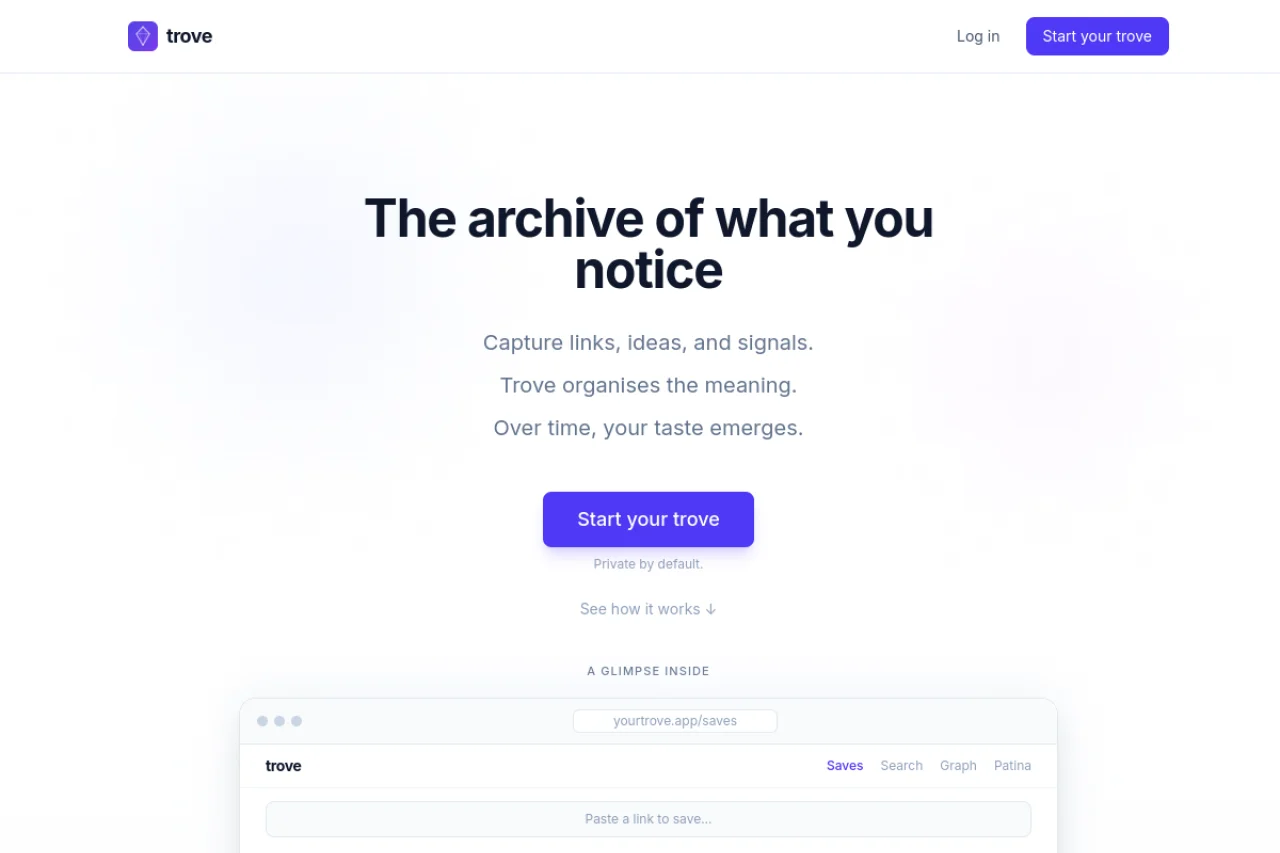
What you save says more than what you post
Most bookmarking tools organise links. Trove analyses them. The premise is simple: the things you choose to save: articles, tools, references, inspiration: form a more honest portrait of your interests than anything you deliberately share on social media.
Every link saved into Trove gets AI-summarised and tagged. Over time, a "Patina" emerges: a taste profile built from the cumulative evidence of what you collect. Topics you return to, themes that connect seemingly unrelated saves, blind spots you did not know you had. It turns passive collecting into active self-discovery.
The name itself matters. A trove is something valuable and hidden: a collection that gains meaning through accumulation. That is exactly what your bookmarks are, if you have the right tool to read them.
Save, analyse, discover
Save a link into Trove and the AI immediately goes to work. It fetches the content, generates a summary, extracts key topics and themes, and files it into your growing collection. No manual tagging required: the intelligence is built in.
Semantic search lets you find anything across your entire collection using natural language. Ask "that article about Japanese design philosophy" and Trove understands the intent, not just the keywords. Your Patina: the taste profile: updates in real time, showing the threads that connect your saves.
The result is a personal knowledge base that understands you better the more you use it. It is the bookmarking tool that finally makes saving links feel worthwhile.
One-click saving on every device
A taste engine is only as good as the signals you feed it. If saving a link requires effort, you will not do it. So I built capture tools for every context you browse in.
Chrome Extension. One click from your browser toolbar. It authenticates with Trove, lets you pick an intent (Read Later, Research, Remember, Act On, Reference) and add tags. The link saves instantly and AI analysis kicks off in the background. You never leave the page you are on.
Safari Mobile Bookmarklet. iOS does not allow native share sheet extensions without a full App Store submission. So I built a Safari bookmarklet for iPhone: tap it from any page and the current URL gets saved straight to Trove. Combined with a mobile-optimised Progressive Web App for managing your collection, saving on the go is as frictionless as saving on desktop.
Both tools feed the same pipeline: save the URL instantly, then extract content, run AI analysis, and generate embeddings for semantic search, all in the background. The user sees "Saved!" before any of that finishes.
"Your bookmarks are the most honest version of you on the internet. Not what you post, not what you like — what you actually save when nobody is watching. That's the real you."
Why it works the way it does
The Patina Concept. Most products give you a dashboard. Trove gives you a Patina — a word borrowed from the way objects develop character through use. Your taste profile is not a chart or a score. It is a living, evolving surface that changes colour and texture as you save more. The metaphor matters because it reframes bookmarking from organisation to self-knowledge. You are not filing links. You are accumulating evidence of who you are.
Why Bookmarks, Not Social. There was a temptation to make Trove social — to let people share collections, follow each other, build public taste profiles. I deliberately chose not to. The moment you add an audience, you change what people save. They start performing taste instead of expressing it. Trove only works if the data is honest, and honesty requires privacy. Your bookmarks are yours.
Semantic Search Over Folders. Every bookmarking tool asks you to organise things into folders or tags. Nobody does it. The links pile up, the folders gather dust, and you can never find anything. Trove skips the pretence entirely. Save the link, let the AI understand it, and search with natural language later. "That article about Japanese packaging design" will find it. No folders required.
The Taste Profile Visualisation. I wanted the Patina to feel like something you could stare at — not a pie chart or a word cloud, but something closer to a mood board that the machine builds for you. The visualisation clusters your saves by theme and shows the connections between them, revealing patterns you would never have spotted yourself. It is the feature that makes people go "oh, that is what I'm actually interested in."
Building a product that reads your mind
AI summarisation is harder than it looks. Getting the AI to summarise a link sounds trivial until you realise that a 10,000-word essay and a product landing page need completely different treatment. The first version produced summaries that were either too long or too generic. It took weeks of prompt refinement to get summaries that actually capture what makes each link interesting — the thing that made you save it in the first place.
People do not know their own taste. The most common reaction when people see their Patina for the first time is surprise. They thought they were into one thing, but the data says something different. That moment of self-discovery is the entire product. I built a bookmarking tool, but the real product is the mirror.
The name carries the product. I spent more time naming Trove than building some of its features. The name had to communicate value, privacy, and accumulation in a single word. When people hear "Trove" they already understand the concept before you explain it. That is not an accident — it is the result of going through about forty terrible names first.
"Everyone talks about curation. Nobody talks about what your curation says about you. That gap — between collecting and understanding — is where Trove lives."
Turn your bookmarks into a taste profile. Start saving with intent.
Visit Trove