Curio
Social signal aggregator and Nuzzel remake. Your network IS the algorithm: links shared by multiple sources bubble up to the top.
Visit forthecurio.com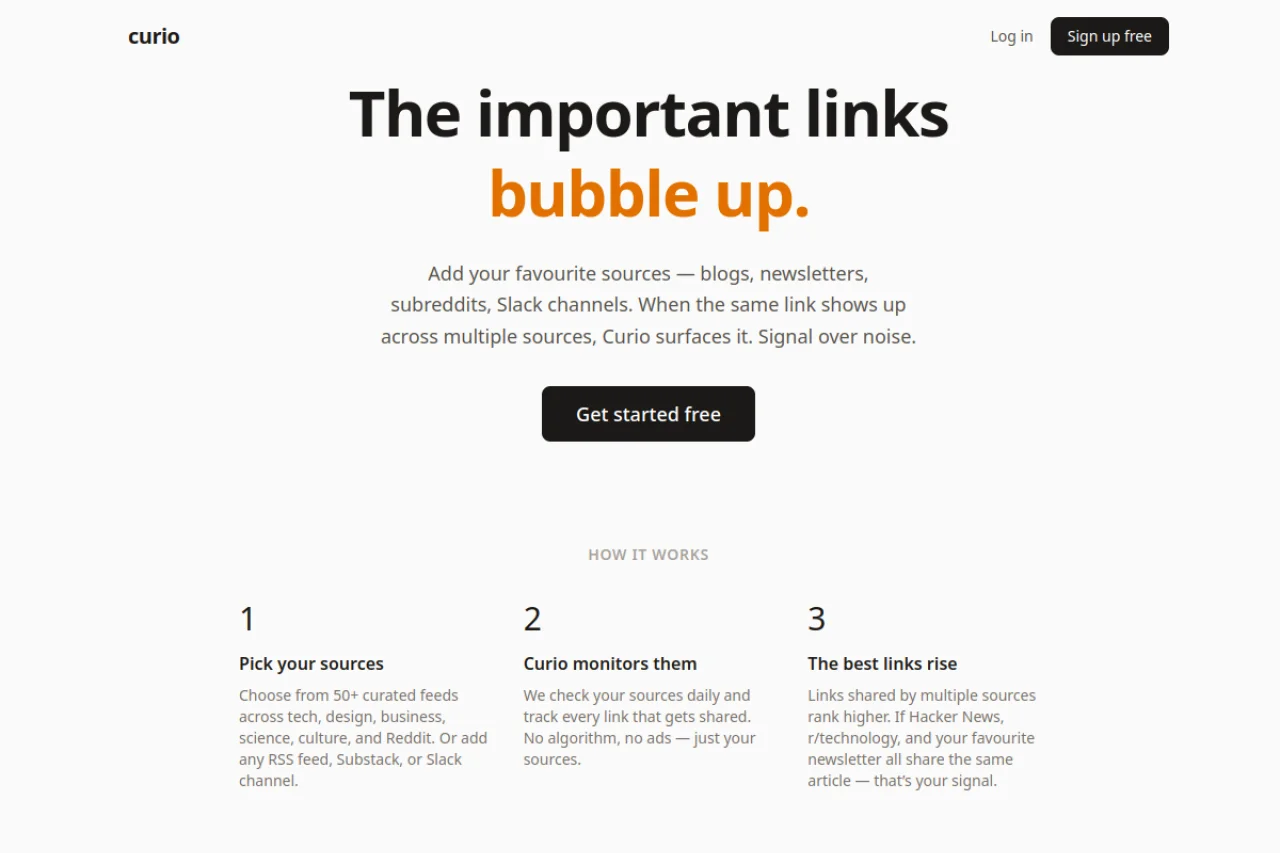
Your network IS the algorithm
Nuzzel was the best product on the internet. It did one thing brilliantly: showed you what your network was sharing. When a link appeared in multiple feeds from people you followed, it surfaced. The more people shared it, the higher it ranked. Simple, transparent, and genuinely useful.
When Nuzzel shut down, nothing replaced it. Social feeds became more algorithmic, more opaque, and worse at surfacing what actually matters. Curio fills that gap with a core principle: the best content filter is not an algorithm: it is the collective judgement of sources you already trust.
The name comes from curiosity. A curio is something rare and interesting: an object worth examining. That is exactly what the best shared links are: things that multiple smart people independently decided were worth your attention.
Signal from noise
Curio connects to RSS feeds, Slack channels, and social signals from sources you choose. When the same link appears across multiple independent sources, it gets ranked higher. Two sources sharing the same article is a signal. Five sources sharing it is a clear signal. Ten sources means you need to read it.
The feed updates continuously, with links ranked by source count and recency. You can bookmark articles for later, receive daily digests of the top links, and browse by topic. There are no recommendations based on engagement metrics or click-through rates: just transparent, source-counted ranking.
"I miss the internet where someone you trusted said 'read this' and that was enough. No algorithm, no engagement score — just a person with good taste pointing at something. Curio is that, at scale."
The choices behind the feed
Network as Algorithm. Every recommendation product uses some form of machine learning to decide what you see. Curio does the opposite. The ranking system is purely social: the more independent sources that share a link, the higher it ranks. No engagement metrics, no click-through optimisation, no personalisation. The algorithm is your network. You can see exactly why something is ranked where it is — because three people you trust shared it. That transparency is the entire point.
Why RSS, Not APIs. The obvious approach would be to connect directly to Twitter and LinkedIn APIs. I deliberately chose RSS feeds and Slack channels instead. APIs are fragile — they change pricing, rate limits, or shut down entirely. RSS has been around since 1999 and will outlive every social platform. Building on RSS means Curio is not dependent on any single platform's goodwill. It also means the sources are broader: newsletters, blogs, podcasts, substacks — anything with a feed.
The Scoring System. Not all sources are equal, and not all sharing is equal. A link shared by three niche industry newsletters is a stronger signal than the same link appearing in three mainstream aggregators. The scoring weights recency, source independence, and source specificity. A link that appeared yesterday from four independent writers outranks a link from last week with six sources. The maths is simple but the result feels like magic — the top of the feed genuinely surfaces what matters.
Aggregation, Not Curation. There is a critical distinction between what Curio does and what a human curator does. A curator applies taste — they decide what is good. Curio applies maths — it surfaces what your network collectively deems worth sharing. The taste is distributed across your sources. Curio just counts the votes. That means it can surface things you would never have found through your own browsing, because your sources are collectively smarter than any single person.
Rebuilding a dead product taught me more than any brief
Simple ideas are the hardest to build. "Show me what my network is sharing" sounds like a weekend project. It is not. Deduplicating URLs that point to the same content, handling redirects, normalising source formats, managing freshness decay — the complexity hides behind the simplicity. The product that feels effortless to use was anything but effortless to build.
RSS is the most underrated technology on the internet. I started this project thinking RSS was a legacy format that only developers used. Turns out it powers most of the internet's best content. Newsletters, podcasts, blogs, even major publications — they all have RSS feeds. The format is robust, standardised, and free. Building on it felt like discovering a secret infrastructure that everyone forgot was there.
People want transparency in their feeds. The single most common reaction from people who try Curio is relief. Not excitement, not delight — relief. They can see why something is in their feed. They can understand the ranking. After years of opaque algorithmic feeds that nobody trusts, showing your working turns out to be a feature in itself.
"Curio looks outward. Trove looks inward. One tells you what the world thinks is interesting. The other tells you what you think is interesting. They are opposite products built from the same conviction: taste matters more than algorithms."
See what your network is sharing. The best links, ranked by source count.
Visit Curio