First Out
The fastest way off the tube. Where to stand on the platform for the quickest exit at 259 London Underground stations across all 11 lines. Journey planner, crowd-sourced verification, commuter favourites, and full offline support.
Visit firstout.app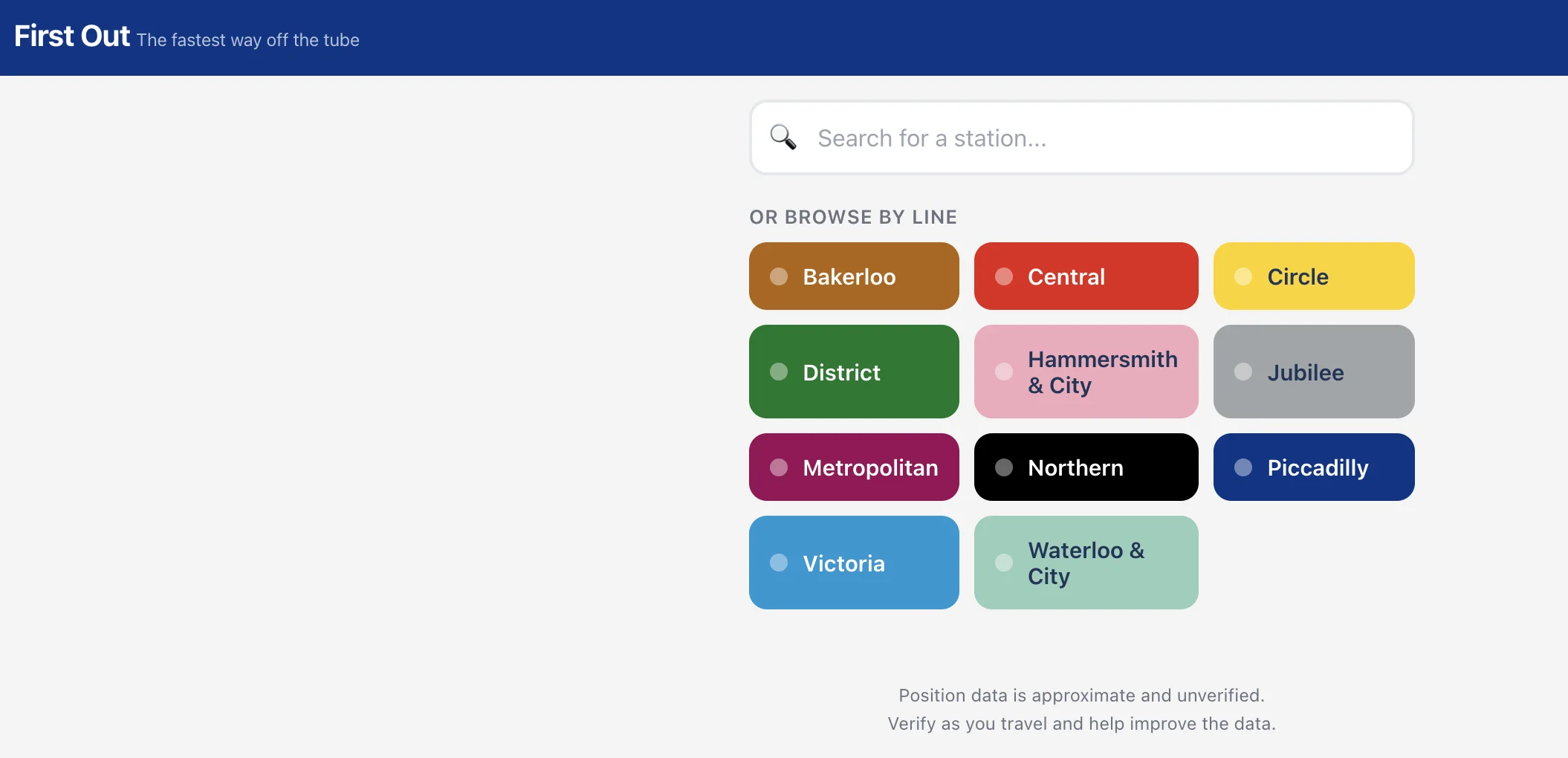
Micro-utility, macro impact
Every Londoner has a theory about where to stand on the tube platform. This makes it definitive. Select your station, select your line, and it tells you whether to board at the front, middle, or back of the train for the fastest exit. Plan a full journey with the From/To planner, save your regular stations as favourites, and help verify the data through crowd-sourced voting. The kind of micro-utility that saves 30 seconds every journey -- and over a year, that adds up.
Search, select, stand
Search or browse 259 London Underground stations across all 11 lines. Select your station and line, and it shows the optimal carriage position (front, middle, or back) for the nearest exit. Use the journey planner to get positioning advice for both your origin and destination. Save commuter favourites for quick access to your regular stations. Crowd-sourced verification lets users vote on whether each recommendation is correct, with live vote counts building confidence in the data. A usage counter tracks journeys optimised across the community. Works offline as a PWA -- install it and use it underground with no signal.
I spent years doing that thing where you sprint to the front of the platform, realise the exit is at the back, and then do the walk of shame past everyone who got it right. This is the app I wished existed every single morning.
Why it works this way
PWA for underground use. This was the single most important technical decision. The tube has no signal. If the app does not work offline, it does not work at all. Building it as a Progressive Web App means you install it once and it runs entirely from your phone, no connection needed. That constraint shaped everything.
Front, middle, or back. I deliberately kept the output to three options. I could have mapped exact carriage numbers or door positions, but that level of detail creates anxiety rather than utility. You are walking down a platform. You need a quick, confident answer: go to the front, middle, or back. Three words. Done.
259 stations, full coverage. What started as 50 stations grew to cover every station on the network. All 11 lines, all 259 stations. If you ride the tube, your station is in here.
Crowd-sourced verification. There is no public API for "which end of the platform is nearest the exit." The initial data came from personal observation, but now users can vote on whether each recommendation is correct. "Is this right?" buttons with live vote counts mean the data gets better with every commuter who uses it.
Journey planner. Single station lookups are useful, but most journeys have two ends. The From/To planner gives you positioning advice for both your origin and destination, with a swap button to reverse direction. One search, two answers.
Building something genuinely small
Constraints make better products. The offline requirement forced me to think about what actually needs to be on the page. No API calls, no loading spinners, no "connecting..." messages. Just data, already there, ready to go. Every product could benefit from asking: what if there was no internet?
Micro-utility has real value. This is a tiny app that does one thing. But when it saves you 30 seconds twice a day, five days a week, it starts to feel essential. I learned that the smallest products can have the most loyal users, because they solve a problem so specific that nothing else bothers to.
Personal frustration is the best brief. I did not do user research for this. I was the user. I stood on the wrong end of the platform enough times that I decided to fix it. That is a lesson I keep coming back to: if something annoys you regularly, it probably annoys other people too.
Thirty seconds saved per journey does not sound like much. But over a year of commuting, that is roughly 4 hours of your life you get back. I will take that.
Know where to stand. 259 stations, all 11 lines, journey planner, crowd-sourced verification, works offline.
Visit First Out