Sociology of Capitalism
The Tension Index. 74 brands scored daily on cultural relevance vs business performance. The gap between the two is the story.
Visit sociologyofcapitalism.com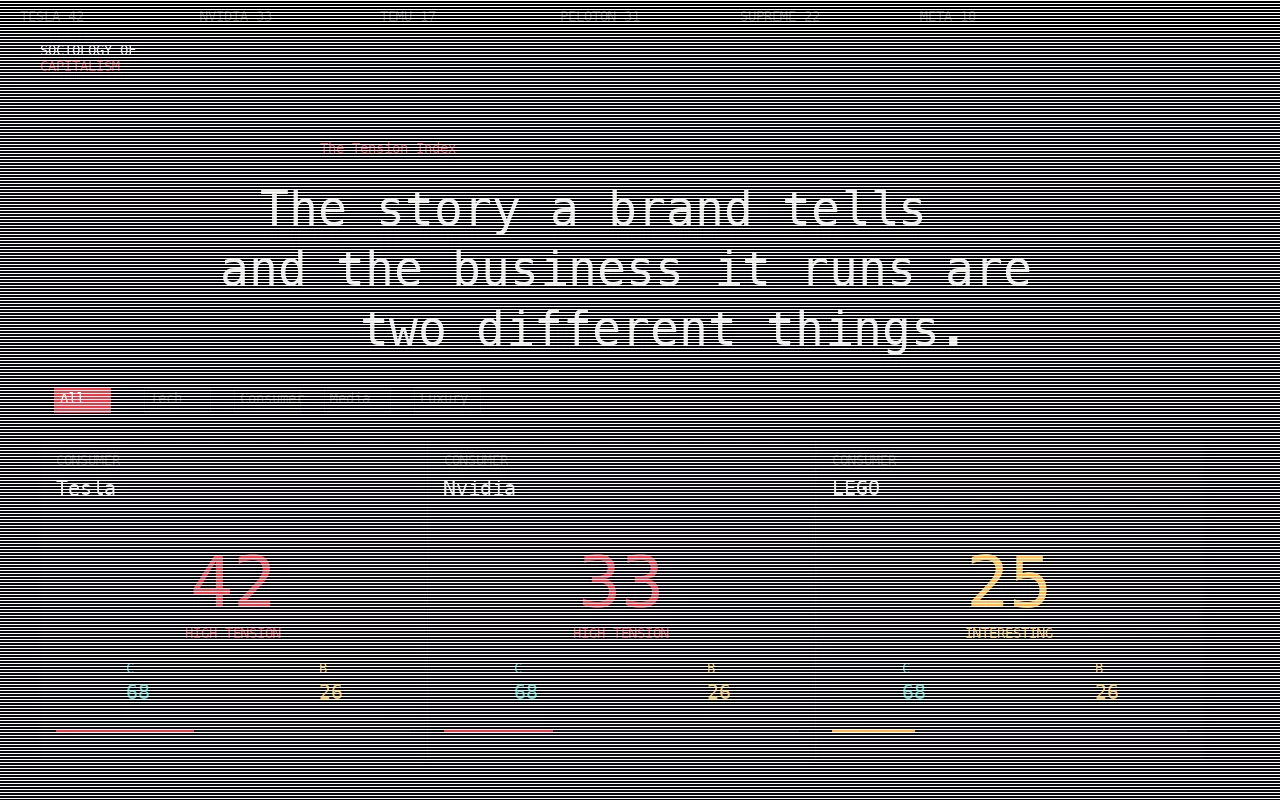
The gap is the story
What happens when a brand is culturally everywhere but financially struggling? Or printing money but culturally irrelevant? The Tension Index measures that gap. It scores brands on two axes: cultural relevance (Wikipedia pageviews, GDELT media coverage, Google News mentions) and business performance (stock price, market sentiment): and the distance between the two reveals something interesting about how brands actually work.
Scrape, score, rank, deploy
An automated pipeline runs twice daily via GitHub Actions (8am and 8pm UTC). It pulls Wikipedia Pageviews, GDELT coverage data, Google News mentions, and Yahoo Finance stock data for 74 brands. Each brand gets a Cultural Score and a Business Score, both normalised to 100. The Tension Index is the absolute gap between them: higher tension means a bigger disconnect between cultural presence and business performance. Results are scored, ranked, and deployed automatically.
"Every strategist talks about cultural relevance. Nobody measures it. I wanted to see what happens when you actually put a number on the gap between what people care about and what shareholders care about."
Why it works the way it works
The Tension Index concept. The core idea is simple: take the absolute difference between a brand's Cultural Score and its Business Score. That's the Tension Index. A brand like Supreme might have massive cultural cachet but modest financials. A brand like Procter & Gamble might be a business juggernaut that nobody talks about at dinner. The gap is where the interesting stories live. |Cultural - Business| = Tension. The maths is basic. The insight isn't.
Wikipedia + GDELT + yfinance as data sources. I needed public, free, reliable data that updates daily. Wikipedia Pageviews tell you what people are curious about right now. GDELT tells you what the global media is covering. Google News adds another signal. Yahoo Finance gives you stock price and market data. None of these sources is perfect alone, but together they create a surprisingly honest picture of where a brand sits culturally vs commercially.
Twice-daily updates. Most dashboards update once a day. I run the pipeline at 8am and 8pm UTC because culture and markets move at different speeds. A brand can trend culturally in the morning after a viral moment and see the business data shift by evening. Two data points per day catches more of those dynamics than one.
74 brands, deliberately curated. I could have tracked 500 brands, but that would have been noise. The 74 were chosen to span categories: luxury, tech, fast fashion, food, sport, media. The curation is the editorial layer. Each brand is there because the tension between its cultural role and its business performance tells a story worth watching.
Lessons from measuring the unmeasurable
Data doesn't replace intuition, it sharpens it. The Tension Index often confirms what you already feel. Of course Tesla has high tension: everyone has an opinion, the stock is volatile, Musk is a lightning rod. But sometimes it surprises you. Brands you'd assumed were culturally dead turn out to be quietly trending. The data doesn't tell you what to think. It tells you where to look.
Free APIs are fragile. Wikipedia's API is rock-solid. GDELT can be temperamental. Yahoo Finance rate-limits you if you're not careful. Building a pipeline on free data means building it to fail gracefully. Every data source has a fallback. Every score has a "last known good" value. Resilience matters more than sophistication when you're running a system twice a day on other people's infrastructure.
Strategy thinking can be a product. This started as a framework I'd sketch on a whiteboard in a planning meeting. "Where does this brand sit culturally vs commercially?" Now it's a live dashboard that updates itself. The biggest lesson is that strategic thinking doesn't have to stay in decks and brainstorms. You can ship it. You can make it real. That's the difference between a strategist who talks and one who builds.
"In fifteen years of strategy, I must have drawn the 'cultural relevance vs business performance' matrix a hundred times on whiteboards. This is the first time I actually built it."
See which brands have the biggest gap between cultural relevance and business performance.
Visit Sociology of Capitalism