The Relevance Index
1,203 brands scored on cultural relevance (0-100) across 5 domains: Attention, Conversation, Creation, Desire, and Zeitgeist. If brands had a credit score for culture, this is it.
Visit therelevanceindex.com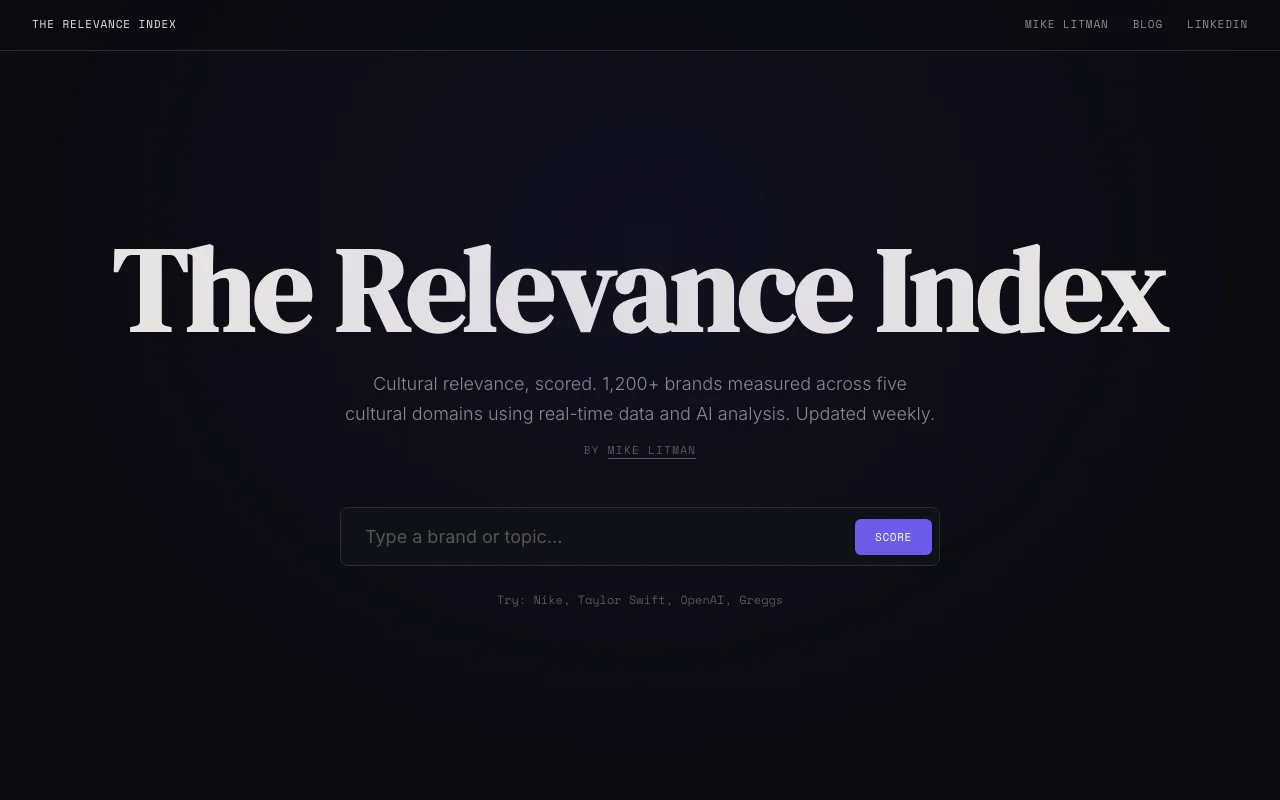
A credit score for cultural relevance
The Relevance Index scores 1,203 brands on a scale of 0 to 100 across five domains: Attention (are people looking?), Conversation (are people talking?), Creation (are people making things about it?), Desire (do people want it?), and Zeitgeist (does it feel like now?). Each brand gets a composite score that tells you exactly how culturally relevant it is, right now. Every brand has its own page. Every category has its own leaderboard. The whole thing updates weekly, automatically.
The scoring pipeline
It's a hybrid model. Wikipedia pageviews and Reddit mentions come from their APIs, giving real signal on attention and conversation. Then GPT-4o-mini scores each brand across the five domains via three independent LLM calls per batch, and the results are averaged to reduce noise. Stock market data enriches 260 brands with market cap and 30-day price change. Claude Sonnet generates the AI insight for each brand. The whole pipeline runs weekly via GitHub Actions every Wednesday at 3am UTC: scrape, score, generate 1,201 individual brand pages and 15 category pages, create OG images with Pillow, and deploy to Netlify.
"Every strategist talks about cultural relevance. Nobody scores it. I wanted a number. Not a vibes check, not a trend report: an actual score out of 100 that updates every week."
Why it works the way it works
Five domains, not one score. A single relevance number would be meaningless. Nike and Supreme are both culturally relevant, but in completely different ways. The five domains (Attention, Conversation, Creation, Desire, Zeitgeist) break relevance into components you can actually reason about. A brand might score 90 on Desire but 30 on Conversation. That gap tells a story. The composite score is useful for ranking, but the domain breakdown is where the real insight lives.
Three LLM calls per batch, averaged. One LLM call gives you confidence. Three gives you reliability. Each batch of brands gets scored by GPT-4o-mini three times independently, and the scores are averaged. This smooths out the randomness that comes with any single generation. It's the same principle as asking three experts instead of one: the consensus is more trustworthy than any individual opinion.
1,201 individual brand pages. Every brand gets its own page with a radar chart, AI-written insight, sparkline history, and stock data where available. This isn't a dashboard you skim: it's a reference you search. When someone Googles "how culturally relevant is Patagonia," the brand page should be the answer. The OG images (generated via Pillow, 1200x630 PNG) mean every brand page shares well on social.
Stock market enrichment. 260 brands carry market cap and 30-day price change. Not because cultural relevance is about stock price, but because the relationship between the two is fascinating. You can sort by market cap and see which trillion-dollar companies are culturally invisible, or which small brands punch absurdly above their weight.
Lessons from scoring 1,203 brands
Scale changes everything. Scoring 74 brands (my earlier project, Sociology of Capitalism) was a prototype. Scoring 1,203 is a product. At that scale, every decision compounds. The pipeline has to be bulletproof. The page generation has to be fast. The OG images have to be templated, not hand-crafted. I learned that the jump from "works for me" to "works at scale" is where most of the engineering lives.
LLMs are surprisingly good at cultural scoring. I was sceptical. But when you give GPT-4o-mini clear rubrics and defined domains, the scores are remarkably consistent and intuitively right. The brands you'd expect to be culturally relevant score high. The ones that feel stale score low. The surprise was how well the model captures zeitgeist: the feeling of a brand being "of the moment." That's the hardest thing to quantify and it turned out to be the most reliable domain.
Embeddable widgets unlock distribution. The badge widget lets anyone embed a brand's relevance score on their own site. It's a small thing, but it turns the index from something people visit into something people use. Every embed is a backlink. Every backlink is distribution. Building for embeddability from the start was one of the best decisions I made.
Email is still the best distribution channel. The Buttondown email digest sends weekly updates to subscribers. Despite all the noise about social media distribution, the email list drives the most consistent traffic. People who subscribe actually read it. The open rates are higher than anything I've seen on social. If I were starting again, I'd build the email list before building the site.
"I went from a whiteboard framework to a live product that scores 1,203 brands weekly, generates individual pages for each one, and deploys itself. A non-coder built this. That's the point."
See how 1,203 brands score on cultural relevance across Attention, Conversation, Creation, Desire, and Zeitgeist.
Visit The Relevance Index