Nihongo
A calm, focused tool for learning Japanese. Flashcards, quizzes, and spaced repetition across 4 levels.
Visit nihongo-app-ml.netlify.app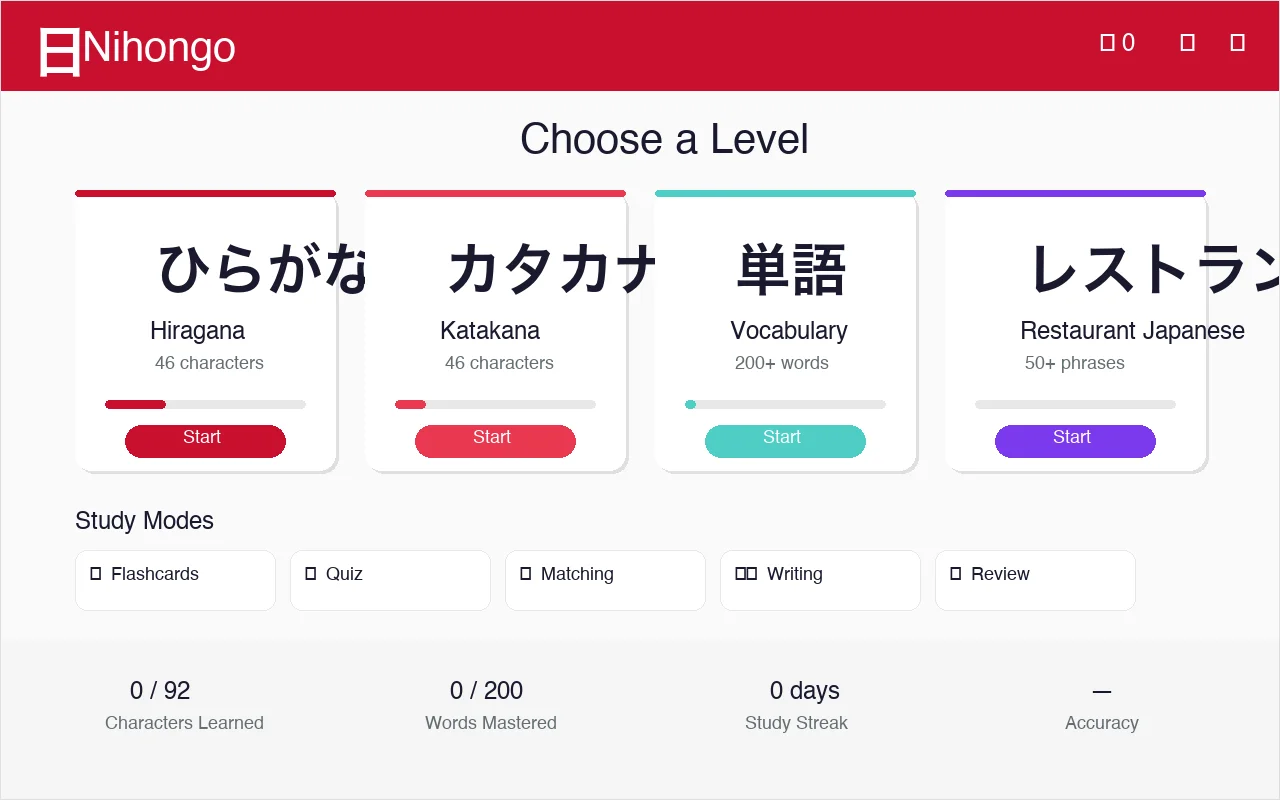
Learning without the noise
Japan is a cultural obsession. The language is the missing piece. Most Japanese learning apps are cluttered and gamified. This one strips everything back to what actually works: spaced repetition with clean design. No streak anxiety, no social features, no noise. Just the characters, the words, and a system that helps them stick.
Four levels, five modes
4 levels of progression: Hiragana (46 characters), Katakana (46 characters), Vocabulary (essential words), and Restaurant Japanese (practical phrases for eating out in Tokyo). 5 study modes including flashcards, multiple choice, writing practice, and SRS (Spaced Repetition System) that surfaces characters you're struggling with more frequently.
"Japan is the only place that makes me feel like a beginner at everything. The food, the design, the way people move through space. Learning the language is the last piece. I built this because every app I tried felt like it was designed by someone who's never been to Tokyo."
Designed for the way I actually learn
Four levels with a practical twist. Hiragana and Katakana are the obvious starting points for any Japanese learner: 46 characters each, the building blocks of the language. Vocabulary builds on that foundation. But the fourth level, Restaurant Japanese, is where this app becomes personal. I added it because the most useful Japanese I know came from eating out in Tokyo. Ordering, asking for recommendations, reading a menu. Most apps treat practical phrases as an afterthought. Here, it's an entire level.
SRS that actually helps. Spaced Repetition System is proven science: show cards you're struggling with more frequently, and space out the ones you know. But most SRS implementations feel clinical. I wanted it to feel natural. The algorithm tracks your accuracy per character and adjusts the interval. Characters you keep getting wrong appear more often without any notification or guilt trip. It just quietly helps you improve.
Five study modes for different brain states. Some days you want to test yourself. Other days you just want to browse. Flashcards for passive review. Multiple choice when you want a challenge. Writing practice for the kinaesthetic learners. SRS mode for focused improvement. Free study for when you just want to explore. Five modes means there's always one that matches your energy level.
Calm design, not gamification. Duolingo turns language learning into a game with streaks, XP, and social pressure. I wanted the opposite. Clean typography, plenty of whitespace, no streaks, no anxiety. The design borrows from Japanese aesthetics: restraint, attention to space, letting the content breathe. Learning a language is hard enough without an app shouting at you.
Lessons from building a learning tool
Building a learning tool taught me about learning. Implementing SRS forced me to understand how memory actually works. The spacing effect, the forgetting curve, the difference between recognition and recall. I started building an app and ended up understanding why I'd failed to learn Japanese three times before. The tool I built is now teaching me better than any app I'd previously tried.
Restaurant Japanese was the best decision. The practical level gets the most use. Not because it's the easiest, but because it's the most immediately useful. You can learn those phrases and use them on your next trip. That direct line from learning to doing is what keeps people coming back. Every language app should lead with practical application, not abstract grammar.
Design is pedagogy. How information is presented changes how it's absorbed. Making characters large and centred, with the romanisation smaller below, trains your eye to focus on the character first. The visual hierarchy is a teaching decision, not just a design decision. Every layout choice in an educational tool is also a learning choice.
"The next time I'm in Tokyo, I want to order in Japanese without looking at my phone. That's the success metric. Not a streak, not XP. Just confidence at the counter."
Learn Japanese the calm way. Hiragana, Katakana, vocabulary, and restaurant phrases.
Visit Nihongo