Buggy Smart
An AI voice agent that rings London cafés, pubs, restaurants and shops to ask one question: can a buggy get through the door? The answers go on a free live map, with every borough ranked on how pram-friendly it really is.
Visit buggysmart.app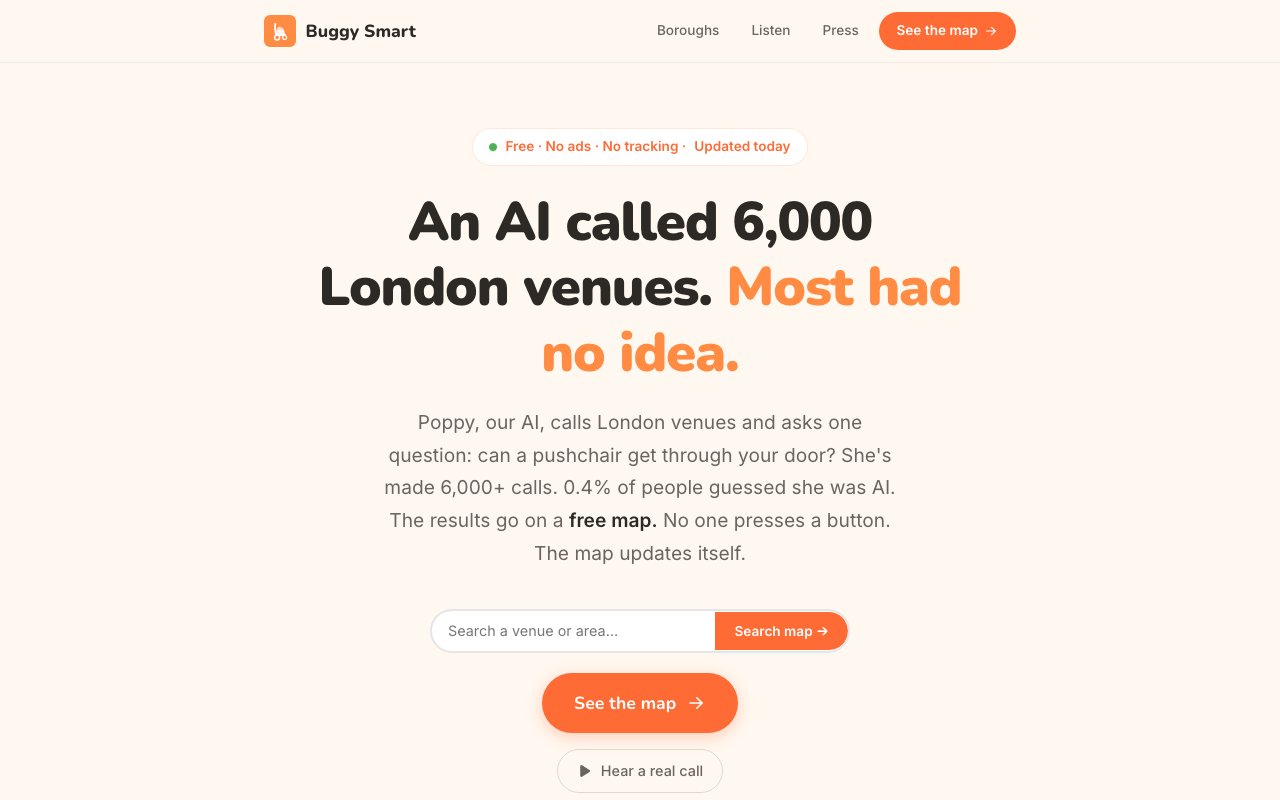
Google Maps doesn't ask
I got tired of arriving somewhere with my son's buggy and being turned away at the door. A step nobody mentioned, no lift, or simply no room between the tables. Google Maps doesn't tell you. TripAdvisor doesn't ask. The only way to know is to ring ahead, or turn up and hope.
So I built Poppy, a voice AI that does the ringing ahead for every parent in London. The idea came from the Guinndex, which called thousands of Irish pubs to track the price of a pint. Same method, different question.
One question, asked 10,000 times
Poppy calls venues through Twilio using ElevenLabs conversational AI. Each call is transcribed, Claude classifies the answer as yes, difficult, no or unclear, and the result lands on the map. No human dials and no human reviews the transcript.
The calls are short: 29 seconds on average. Only 4 of 1,277 rated venues worked out they were talking to an AI, and a handful had AI receptionists of their own, which made for four AI-to-AI calls.
Boroughs are ranked on one number, the yes-rate: the share of venues called that said yes outright. The home page and the boroughs page both work it out live from the call data, so they can never disagree about who is top.
Every pin on the map is a real conversation. Poppy asked. A human picked up. The answer is on the map.
Most venues can fit a buggy. Half say yes outright
Across 1,277 rated venues, 90% can accommodate a buggy in some way, but only 52% said yes outright. Walthamstow leads the boroughs at 63% from 52 venues, with Hackney a point behind at 62% from 113. Peckham is the toughest, at 25%.
GAIL's Bakery is the most consistently accessible chain: 24 of 31 branches said yes and only 2 said no. A supermarket comparison is next, with 41 branches rated so far.
Figures as of September 2026. The live map has the latest.
Voice agents find data no website holds
Phone calls unlock data that websites hide. A venue's website sells the food, not the doorway. A thirty-second call gets an answer no listing contains.
Data can get better after it is collected. The classifier re-evaluates past calls as it improves, so old ratings sharpen over time. One night in April 2026, 184 venues joined the map without a single new call.
Know when the pool is worked out. By autumn 2026 nearly every reachable venue in London had been called, so the calls moved from daily to a monthly batch. The map keeps its value; the phone bill doesn't.
Building it cost under £300. Doing the same research by hand would cost over £5,000 and take two months.
Check a venue before you set off with the pram.
Visit Buggy Smart