Beat the Gaffer
A football prediction game fronted by a comic character. Predict the scores, climb the table, and settle the score with the Gaffer: the manager football never gave the big job. Live for the Premier League 26/27 season, with a real audience and a business partner.
Visit beatthegaffer.com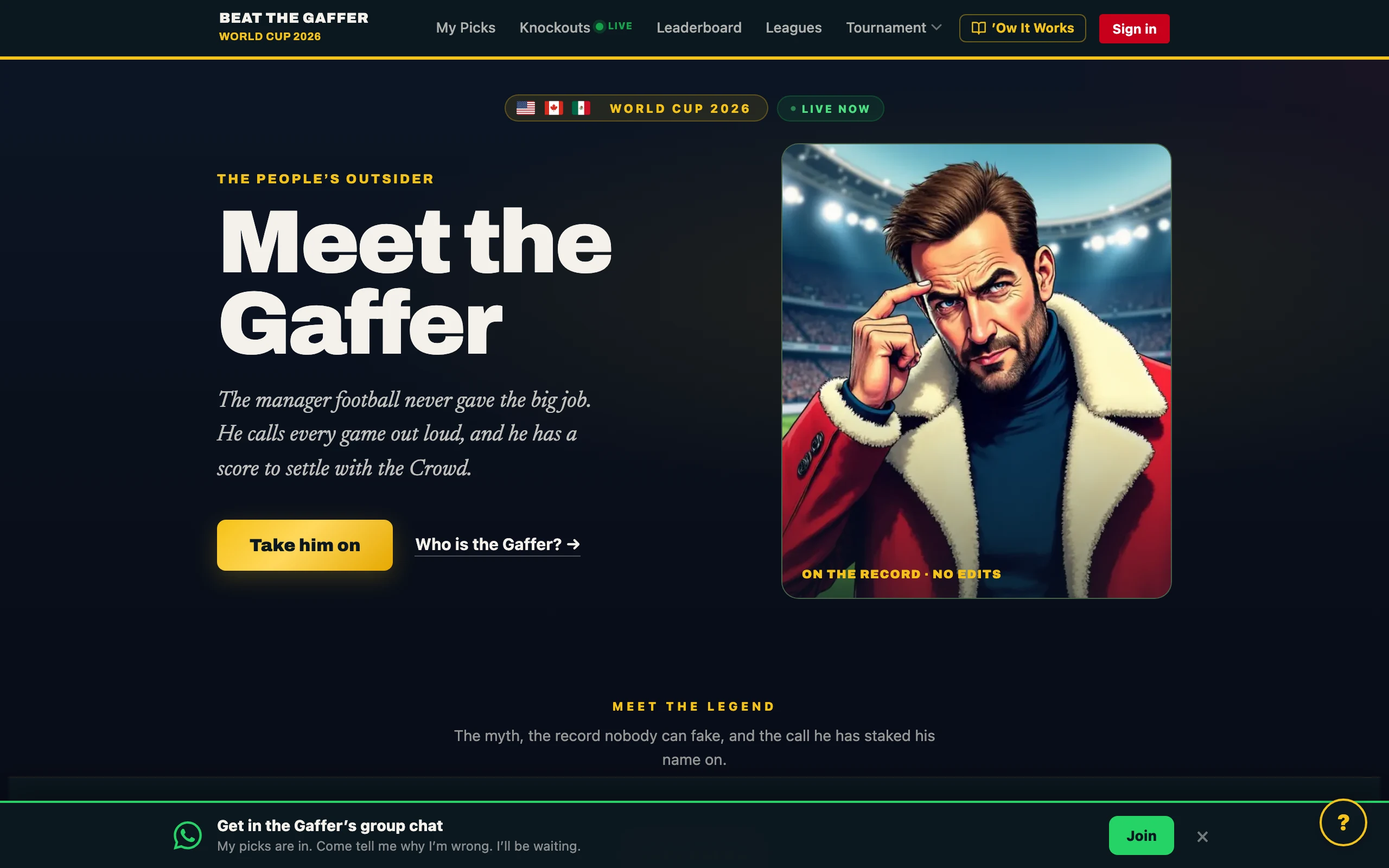
The character is the product
Every football prediction game looks the same. A grid of fixtures, a points total, a league table, a sponsor's logo. They compete on mechanics, and mechanics are infinitely copyable. The moment one app adds a multiplier chip, every other app adds the same chip by the weekend.
Beat the Gaffer starts from the opposite end. It begins with a character: the Gaffer, the manager football never gave the big job. He calls every game out loud, he has a record nobody can fake, and he has a score to settle with the crowd. The predictions game is simply his home ground, the place where you take him on. The fixtures and the table are the floor he stands on, not the reason you turn up.
That inversion is the whole bet. Mechanics are a commodity. A character with a voice, a face, and a point of view is not. It is the one thing a copycat cannot clone, because cloning it would just be doing an impression of someone else's joke.
Predict, lock in, get judged
You predict the scoreline for each match before kickoff. Get the exact score and you bank the most points; get the result and goal difference and you still score well; get the winner and you score something. Picks lock the moment the whistle blows, enforced server-side so nobody can edit history after the fact.
Around that sits a league table, private leagues you can run with friends, and the Gaffer himself reacting to how you did. He has his own set of picks every round, so the real game is not just topping the table: it is beating the Gaffer. Win and he has to wear it. Lose and he will not let you forget it.
"Most prediction games are a spreadsheet with a logo on it. The Gaffer is a character whose home ground happens to be a predictions game. Build for the character first, and the mechanics stop being the thing people can copy."
The choices behind the game
A reactive face, not a mascot. The Gaffer is drawn as a full comic-book character with a library of facial states, smug, fuming, vindicated, sheepish, so the product can react to your result with an actual expression rather than a generic notification. The face does the emotional work that copy alone cannot. He is a character you play against, not a logo in the corner.
Lock it down at kickoff. The integrity of any prediction game lives or dies on whether picks can be edited after the fact. Every prediction is locked server-side the instant a match starts, with a database-level guard, not just a hidden button. The game is only fun if everyone trusts the scoreboard.
Simple to play, hard to put down. Real user feedback was blunt: brilliant, but do not make me think. So the join flow, the picking, and the scoring are being stripped back to the fewest decisions possible, while the personality is turned up. Clutter is what buries a product like this; the character is what carries it.
It runs itself. Fixtures, scoring, the Gaffer's own picks, and the post-match reactions are driven by scheduled jobs rather than by me sitting at a keyboard on match nights. A live product with a real audience cannot depend on its maker being awake.
Building a live product with real users changes everything
Personality is the moat. The features people praise are the ones that sound like the Gaffer, not the ones that add a column to the table. Every time I have been tempted to compete on mechanics, the honest answer has been to make the character louder instead.
Complexity is the enemy of a casual game. The feature you are proud of is often the one a new player bounces off. The hardest discipline has been removing things, keeping the lock-in step and the scoring legible enough that someone's dad can play it on their phone at half time.
Live means no quiet failures. With a business partner and real players, a silent bug on a match night is a real cost, not a tidy line in a backlog. It has pushed me towards loud failures, server-side guards, and verification before anything ships.
"The test for every decision is simple: does it amplify the Gaffer, or does it just add another mechanic? Keep the character, demote the commodity. That is the entire product strategy on one line."
Pick the scores. Climb the table. Beat the Gaffer before he beats you.
Play Beat the Gaffer