The Queue Index
If there's no queue, is it even good? Every Saturday, an AI voice agent calls London's most sought-after no-reservation restaurants and asks a simple question: how long is the wait right now? The answer becomes a live league table of the city's most in-demand venues.
Visit thequeueindex.com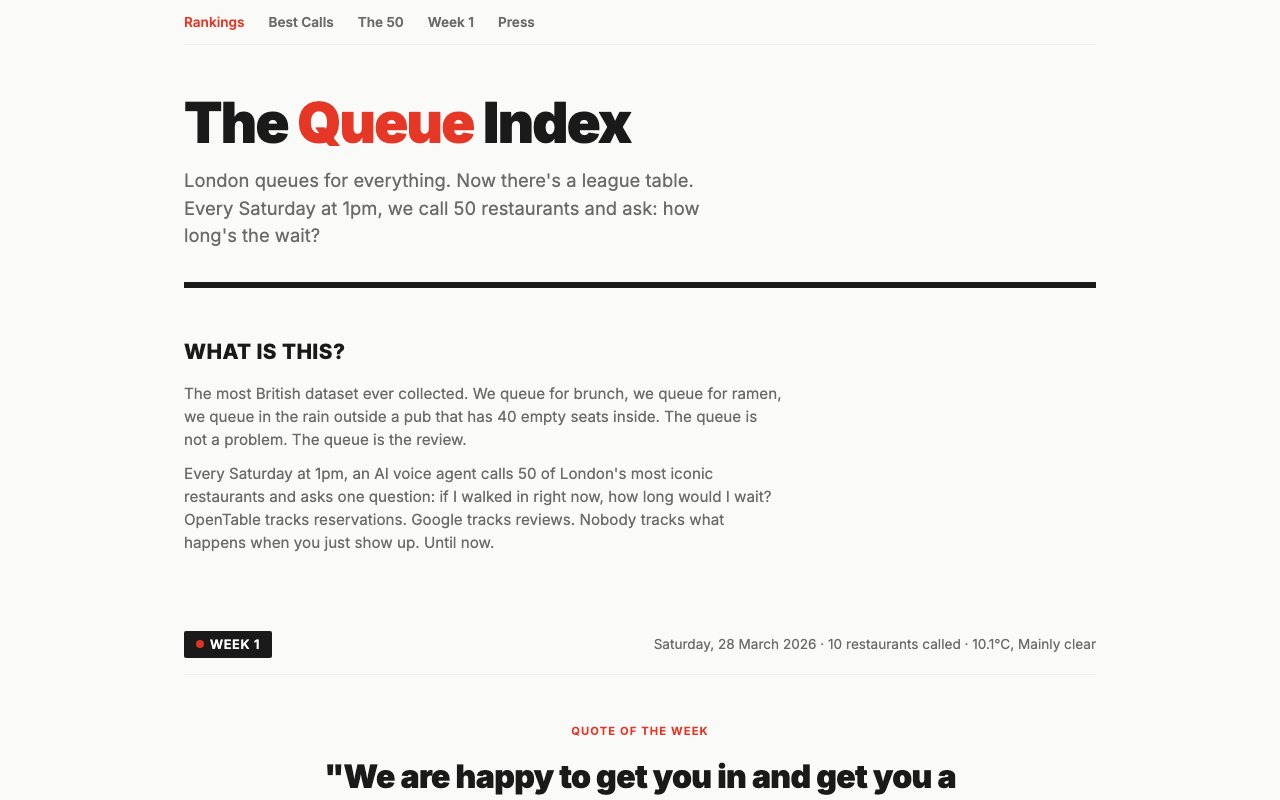
Britain's most British dataset
Britain is the only country in the world where standing in a queue outside a restaurant is considered a recommendation. The queue is not an obstacle. It is a signal. It tells you that the food is good enough that people will wait for it, that the place does not take bookings because it does not need to, and that if you are not there early you are not getting in.
That signal has never been measured. There is no league table. No one has systematically tracked which restaurants in London have the longest waits on a Saturday afternoon. The Queue Index fixes that. Every Saturday, the AI calls the list, records the answers, and builds a ranking from the real-time data.
The queue is not a problem to solve. The queue is the review. And now there is a league table for it.
Automated. Weekly. Real.
Every Saturday afternoon, a voice agent calls each restaurant on the Queue Index list and asks the question: "If I came in now, would there be much of a wait?" The answer – a time, a shrug, a confident "no queue at all" – gets transcribed, classified, and structured into a wait-time data point.
The calling pipeline runs on Railway. Transcripts are processed via the ElevenLabs API and parsed by a Claude pipeline that extracts the key information: wait time in minutes, tone, any notable quotes from the call. The data is then pushed to the site via GitHub Actions, which regenerates the league table and republishes.
The quotes are deliberately surfaced. A number tells you how long to wait. A quote tells you what kind of place it is. "There isn't, no. It's not busy tonight." "About forty-five minutes, I'm afraid." "I already say yes" – that is Paradise in Kensal Rise, and it tells you everything you need to know.
"A nation that queues for everything finally has the data." Week 1: 29 out of 42 venues with live wait data. 69% success rate. The most British dataset ever collected.
Building the data infrastructure for a new kind of guide
Timing dictates data quality. Calling at 1pm on a Saturday catches the lunch rush but misses dinner-only venues. Venues like The Barbary and Berenjak do not open until the evening. A staggered calling schedule by opening hours dramatically improves coverage. The infrastructure learned quickly that restaurant time is not uniform.
The classifier needs generosity. An early version of the transcript classifier was too strict, rejecting answers like "0 minutes" and "be soon" as failures. The fix: be generous. If the restaurant communicated something about wait time or walk-in policy, that is a successful call. IVR policy information counts. "We're full tonight" is data.
Hardcode what does not change. Dishoom has seven London locations, all with identical IVR systems that play the same walk-in policy recording. There is no need to call Dishoom every Saturday. Hardcode the policy, do not burn calls on it, and use those calls on venues where the answer might actually change week to week.
The product improves with iterations. Week 1 success rate: 23%. After prompt improvements, classifier tuning, and timing adjustments: 69%. Voice AI pipelines reward iteration. The infrastructure is the same; the intelligence around it is what compounds.
Other countries have restaurants. We have queues outside restaurants. The Queue Index is the only guide built around the thing London does better than anywhere else: wait.
The most British dataset ever collected. Updated every Saturday.
Visit The Queue Index