A Chrome extension, an iPhone bookmarklet,
and the case for owning your own workflow.
Every read-it-later app made the same promise: save now, read later. Pocket. Instapaper. Now Matter and My Mind. But "later" never comes. The link sits in a list. You forget why you saved it. Buried treasure that stays buried.
Three weeks later, a brief landed that was exactly about this. I knew I'd saved something relevant. I could feel it. But I couldn't find it. Not in Pocket (back when it existed). Not in my bookmarks. Not in the 47 open tabs I'd closed since then.
That was the moment I decided to build something that would remember for me.
Too much friction. Open app, paste URL, pick folder, add tags. By the time you're done, you've lost the thought.
Zero intelligence. They store your link. That's it. No analysis, no themes, no connections between the things you save.
No mobile story. Half of what you discover happens on your phone. If saving means switching apps, it won't happen.
click to save.
That was the brief I gave myself.
The name means "a treasure hoard." That's the idea. Save a link. AI extracts the content, analyses themes, maps entities, classifies tone, and generates an embedding for semantic search. Your library becomes a treasure chest that organises itself.
Every link you save is a gold coin dropped into the chest. Over time, those coins compound into a pattern. Trove calls this your Patina: the residue of your intellectual curiosity, made visible.
It tracks your top themes, the domains you keep returning to, the entities that keep appearing, the tone of writing you're drawn to. Not as data points, but as a portrait. Matter and My Mind tell you what you saved. Trove tells you who you are based on what you save.
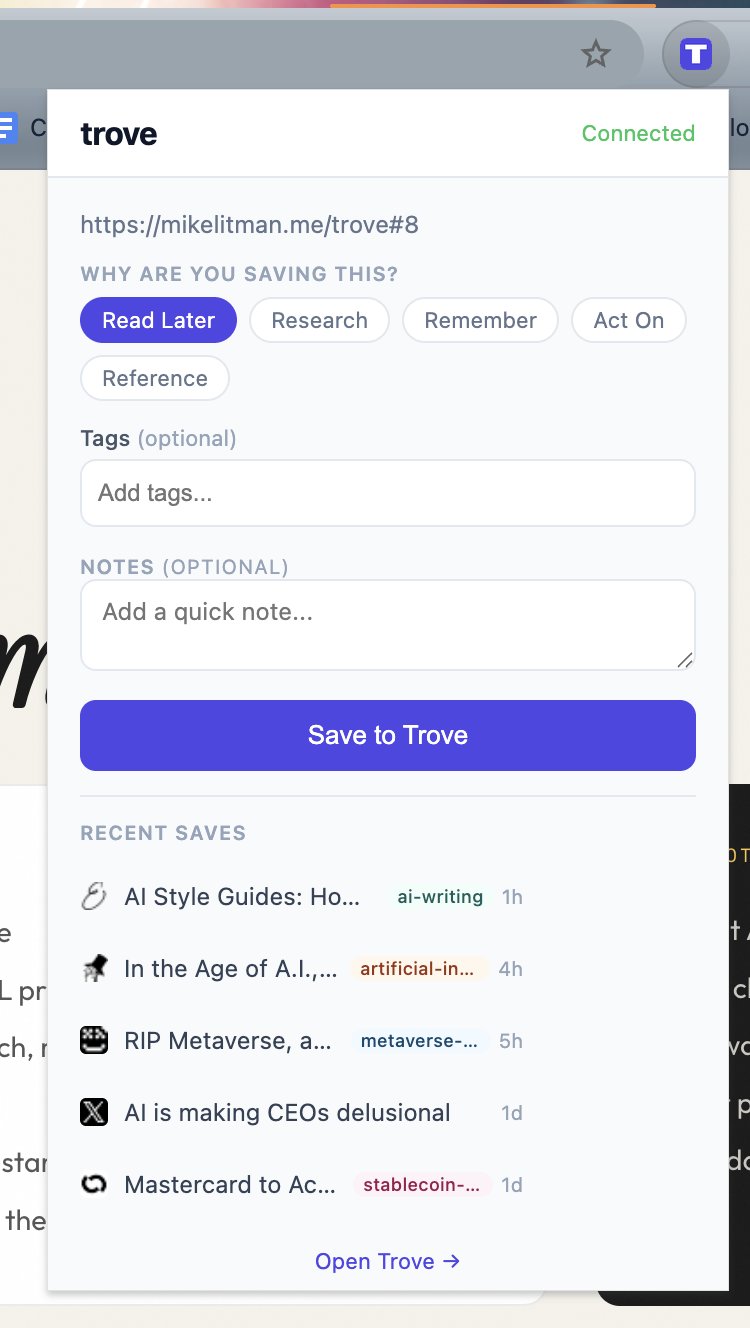
There's a T in my browser toolbar. I click it. That's the entire workflow.
The page URL is already there. I pick an intent, hit save, and the AI pipeline starts before I've switched back to the tab. Recent saves show at the bottom so I can see what I've been collecting.
Half of what I discover happens on my phone. In bed. On the train. Walking. If saving requires opening a separate app, it won't happen.
I saved a piece about how Hermès uses scarcity as a brand strategy. Within seconds, Trove had tagged it with luxury positioning, artificial constraint, and cultural signalling.
Then it connected it to four other saves I'd forgotten about: a piece on Supreme's drop model, an essay on why Noma closed at its peak, a Nike article about limiting colourway runs, and a thread about how Spotify deliberately throttles Wrapped access.
I didn't search for those connections. They emerged. That's the difference between burying treasure and drawing a treasure map.
The Chrome extension took an evening. The bookmarklet took an hour. The AI pipeline took a weekend. None of it required a team, a sprint, or a standup.
This is what building looks like now. You don't need permission. You don't need a budget. You need a problem that bothers you enough to solve it, and a weekend where you'd rather hunt for treasure than scroll.
Every feature starts the same way: what would I build if no one else was going to build it for me?
The best tools are the ones you build for yourself.
When you own the save action, you control the entire pipeline from intent to intelligence. No vendor lock-in. No feature requests. No waiting. Just the exact workflow you need, built in a weekend.